
Organize donor names for a donor recognition wall in a single master list, choose a consistent display order, and obtain approval for every public inscription before production. Alphabetical order suits equal recognition; giving-level groups suit campaigns with published recognition tiers. Keep contact details, gift records, and private notes separate from the text that will appear on the wall.
- A donor recognition wall needs one approved name list, a consistent order, and permission to publish each inscription.
- Alphabetical order supports equal recognition; giving-level groups require clear campaign rules.
- Bricks R Us suits organizations considering engraved bricks, pavers, and donor-recognition products.
- Proof names in the proposed layout before approving engraving or installation.
Why this matters
A donor list becomes a public record when you engrave it. A misspelled name, unwanted disclosure, or unexplained placement can distract from the community purpose behind the gift.
Bricks R Us designs and sells custom engraved bricks, pavers, and donor-recognition products. Whatever material you choose, settle the recognition rules before arranging the names; an attractive layout cannot resolve an unclear policy.
How do you organize donor names for a donor recognition wall?
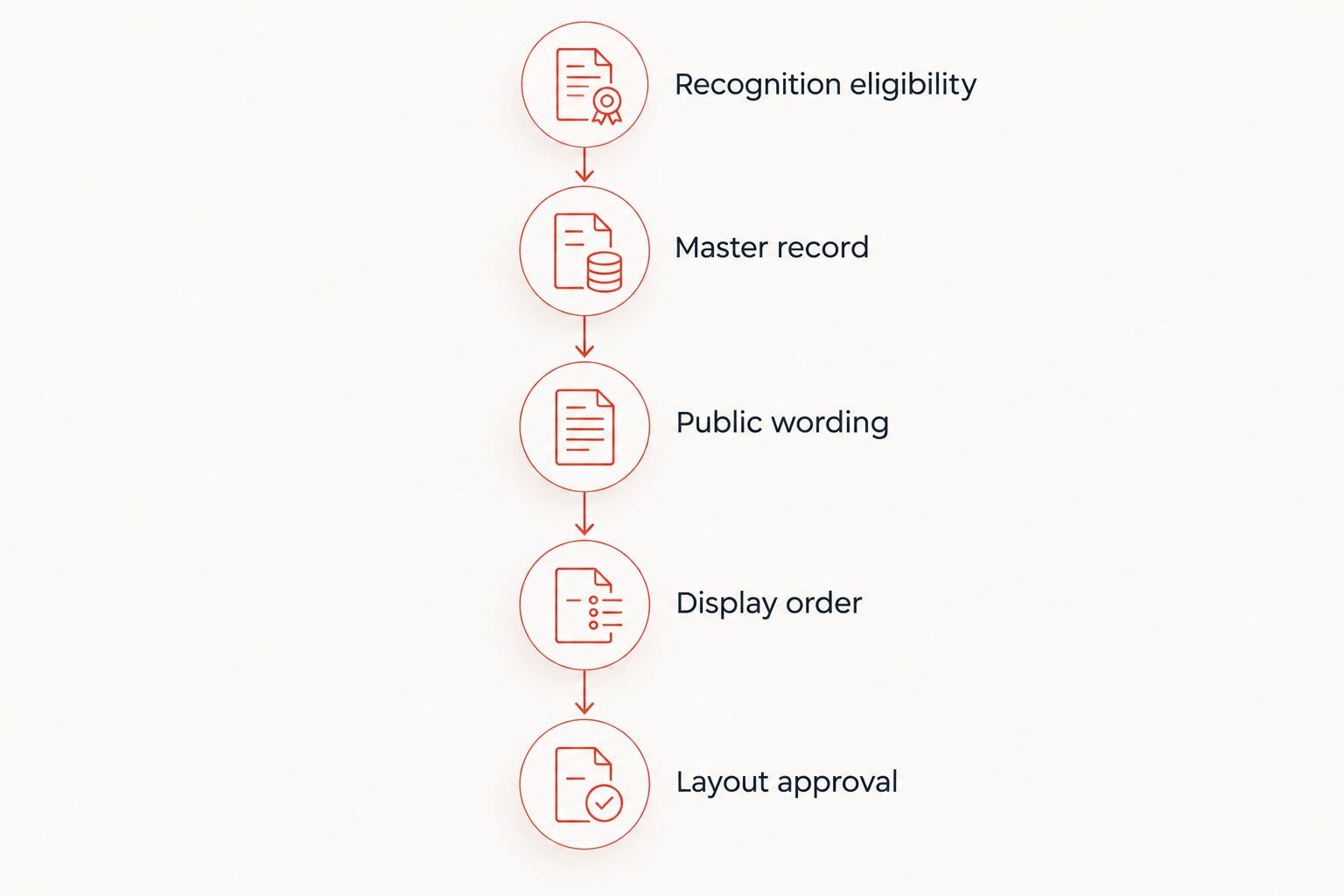
Start with approved names, not the wall design. Use the following sequence to move from donation records to a display-ready list without treating a payment receipt as permission to publish.
1. Define recognition eligibility
Write down which campaign gifts qualify for the wall, what event establishes eligibility, and whether the display recognizes donors, honorees, or both. Decide how your organization will handle pledges, matching gifts, joint gifts, and anonymous contributions before assigning positions.
For a 2026 campaign, distinguish the campaign year from the installation date. A donor who qualifies under your published rules should not disappear from the list because installation happens later.
2. Build the master record
Maintain 1 master record per proposed inscription, with a separate identifier connecting it to your internal donation records. A household inscription can represent several contributors; several tribute inscriptions can also relate to one contributor.
Use these fields as a working checklist:
- Record identifier and internal donation reference.
- Donor contact and designated approver.
- Exact public inscription, including punctuation.
- Donor or honoree status.
- Recognition group and sorting field.
- Permission, proof status, and approval date.
- Proposed location and production status.
Restrict access to contact information and gift details. Export only the fields needed for proofreading, layout, or production.
3. Confirm the public wording
Ask donors how they want their recognition to read rather than copying the name on a payment record. Confirm initials, family names, organization names, titles, accents, and memorial wording.
Separate display text from sorting text. A family inscription can display exactly as approved while a dedicated surname field determines its alphabetical position. That separation prevents punctuation or introductory wording from sending a name to an unexpected location.
4. Assign the order
Choose alphabetical, giving-level, chronological, or location-based organization using the comparison below. Document the rule in plain language so another committee member can reproduce the same order.
Apply the rule to the entire approved list before making aesthetic adjustments. If a layout change moves a name out of sequence, resolve the conflict explicitly rather than quietly creating an exception.
5. Proof the layout
Use 2 approval stages: inscription approval and layout approval. First, confirm each public inscription with its designated approver; then have the organization review the complete arrangement for omissions, duplication, grouping, and legibility.
Record which version received approval. A later edit requires a fresh check of the affected inscription and its position, even when the change looks minor.
Which donor-name arrangement should you choose?
There is no single arrangement that fits every campaign. Choose the rule that matches what you promised donors, then use the layout to make that rule easy to understand.
| Arrangement | Best for | Main benefit | Main limitation |
|---|---|---|---|
| Alphabetical order | Equal public recognition | Gives visitors a familiar way to find names | Requires rules for households, businesses, and naming exceptions |
| Giving-level groups | Campaigns with published recognition tiers | Reflects the campaign's stated recognition structure | Requires consistent treatment of qualifying gifts |
| Chronological order | Displays intended to record participation over time | Preserves the sequence of approved entries | Names are harder to find without a directory |
| Location-based groups | Projects recognizing distinct communities or purposes | Connects recognition to a meaningful place or group | Category boundaries need clear definitions |
Alphabetical order: best for equal recognition
Alphabetical order is a practical default when your campaign does not promise different placement by contribution level. Use the same name treatment and sorting method throughout the display.
Decide whether organizations sort by their complete names and how you will handle introductory articles. For households, ask for a sorting surname rather than inferring one from the first word of the inscription. Record exceptions so a future organizer does not have to reconstruct the reasoning.
Giving-level groups: best for published recognition tiers
Group donors by giving level only when that structure matches your campaign commitments. Within each group, alphabetical order supplies a consistent secondary rule.
Confirm how your organization assigns joint gifts, employer matches, and pledges before publishing the list. Do not display contribution amounts or private gift details merely because those fields exist in your records. Recognition categories and financial records serve different purposes.
Chronological order: best for an ongoing participation record
Chronological order works when the sequence itself matters, such as a display organized around campaign phases. Define which event controls the order: receipt, eligibility confirmation, or inscription approval.
The drawback is findability. If you choose chronology for a 2026 installation, consider a separate name directory and assign responsibility for keeping it consistent with later additions.
Location-based groups: best for distinct communities
Location-based grouping can separate recognition by campus, congregation, team, neighborhood, or project area. Use group names donors recognize and give each inscription an unambiguous destination.
This approach needs an exception rule for contributors connected to several groups. Ask the donor to select a location where appropriate instead of duplicating recognition without a policy.
Why donor-name organization varies
The right arrangement depends on your commitments and the physical display, not on which spreadsheet sort looks neatest. Check these factors before finalizing your 2026 recognition plan:
- Campaign promises: Honor published recognition categories and any agreed placement commitments.
- Inscription purpose: Distinguish the person making the gift from the person being honored.
- Naming structure: Set rules for households, businesses, teams, and other shared inscriptions.
- Display format: Confirm the usable inscription space and layout requirements before approving text.
- Future additions: Decide how new names enter the display without breaking its organizing rule.
- Privacy preferences: Provide a documented way to decline public recognition or approve alternative wording.
Treat these as decisions to settle, not reasons to create a different process for every donor. A short policy makes exceptions easier to discuss fairly.
How should different organizations apply the same rules?
Use the same approval process across organization types, but adapt the naming questions to the people you recognize. The examples below are planning choices, not claims about existing campaigns.
| Organization | Names to clarify | Practical recommendation | Watch-out |
|---|---|---|---|
| Nonprofit | Individuals, households, foundations, and businesses | Best for mixed donor lists: collect a separate display name and sorting name | A payment account name does not establish the desired public inscription |
| School or university | Alumni, families, classes, and student organizations | Best for campus recognition: confirm any class or group wording with the approver | Do not infer a graduation year or affiliation |
| Church | Congregants, families, ministries, and memorial honorees | Best for congregation projects: distinguish gifts from tribute wording | A donor's name and a memorial name are not interchangeable |
| Municipality or community memorial | Residents, civic groups, and people being remembered | Best for civic projects: publish eligibility and approval responsibilities | Resolve shared-space permissions before promising placement |
| Sports organization | Athletes, families, teams, coaches, and sponsors | Best for team recognition: define whether entries represent people or groups | Avoid adding a season, role, or team affiliation without confirmation |
Give each group the same opportunity to approve its wording. A busy school office, volunteer church committee, nonprofit team, municipal coordinator, or sports organizer all need a clear record of who approved what.
How do you handle anonymous donors and memorial names?
An anonymous gift does not authorize public recognition. Record the donor's preference privately and confirm whether the donor wants no inscription, approved anonymous wording, or recognition of an honoree instead.
For memorials, identify the person authorized to approve the tribute. Confirm the honoree's name, any dates, and any dedication language without filling gaps from memory or public searches. Keep the contributor's contact information separate from the memorial inscription.
For your 2026 production file, include only approved public text. Internal labels such as pending, anonymous request, or awaiting family response belong in administrative fields, not in an export that someone could mistake for engraving instructions.
How do you add donor names after the wall is installed?
Decide how additions will work before approving the original layout. A display with strict alphabetical placement needs a different update plan from a display organized by dated sections.
Choose an approach with your designer or installer, and confirm what the physical system permits. Reserved space, replaceable components, or a separate later section are planning options—not assumptions you should make about a particular product.
Maintain 1 location reference per installed inscription so the next organizer can connect the physical display to the master record. After an addition, update the directory and record what was actually installed, not just what was ordered.
What should you check before approving production?
Read the final proof as a visitor would, then check it against the master record. Spell-checking alone will not catch a correctly spelled but incorrect surname.
- Match every inscription to its approval record.
- Check accents, initials, punctuation, and line breaks.
- Confirm that each approved inscription appears once unless duplication is intentional.
- Recheck alphabetical order within every group.
- Review headings and group assignments.
- Verify that private information has not entered the public file.
- Confirm future-addition plans with the people responsible for the display.
Bricks R Us is best suited to organizations considering custom engraved bricks, pavers, and donor-recognition products. The product choice supports the recognition plan; it does not replace your organization's decisions about eligibility, privacy, or approved wording.
Request a free sample brick before settling on an engraved-brick approach. Use it to discuss the physical format with your committee, then confirm the requirements for your proposed inscription rather than assuming a sample establishes every layout detail.
Request a free sample brick
Review an engraved brick with your committee before choosing your recognition format.
FAQ
What's the best way to organize names on a donor recognition wall?
Alphabetical order is a practical default for a donor recognition wall when the campaign promises equal recognition. Use giving-level groups when they reflect published campaign commitments, and alphabetize within each group.
Should donor names appear alphabetically or by donation level?
Use alphabetical order for equal recognition and donation-level groups for a campaign with established recognition tiers. Decide the rule before arranging names, and document how exceptions are handled.
How do I list a family on a donor wall?
Ask the family to approve its exact public inscription and provide a sorting surname separately. Do not assume the name on a payment record is the wording the family wants displayed.
Can I put an anonymous donor on the recognition wall?
Include an anonymous donor only in the form the donor has approved for public recognition. Keep the donor's identity and contact information out of the public production file.
Who should approve a memorial inscription?
Have the designated tribute approver confirm the memorial inscription before production. Record approval of the name, dates if included, dedication wording, and final line breaks.
How many approvals should donor names receive?
Use 2 approval stages: inscription approval and layout approval. Confirm the public wording first, then check the complete arrangement for omissions, duplicates, grouping, and placement.
Can Bricks R Us help us consider an engraved-brick display?
Bricks R Us designs and sells custom engraved bricks, pavers, and donor-recognition products. Request a free sample brick to review the physical format while your organization develops its inscription and approval rules.
One last thing
The name you display does not have to be the name you sort by. Keeping those fields separate lets you respect a donor's approved wording without sacrificing a usable alphabetical system.
Before closing your 2026 campaign records, assign an owner to the master list and record where the approvals are stored. The next committee should inherit a usable recognition record, not a folder of competing spreadsheets.