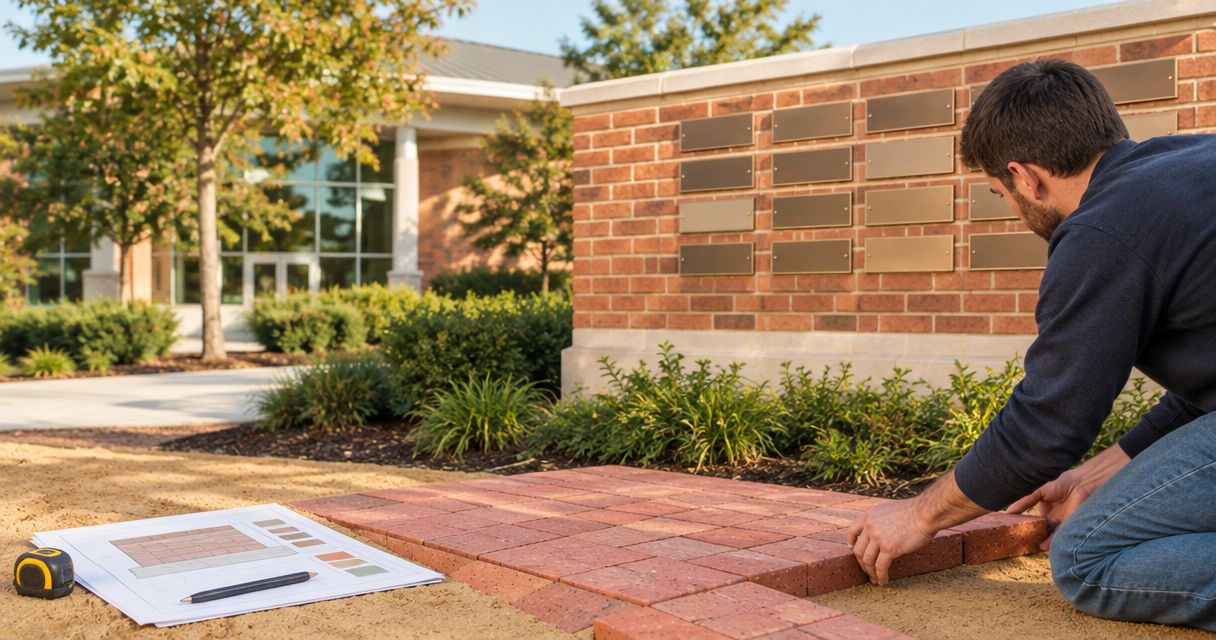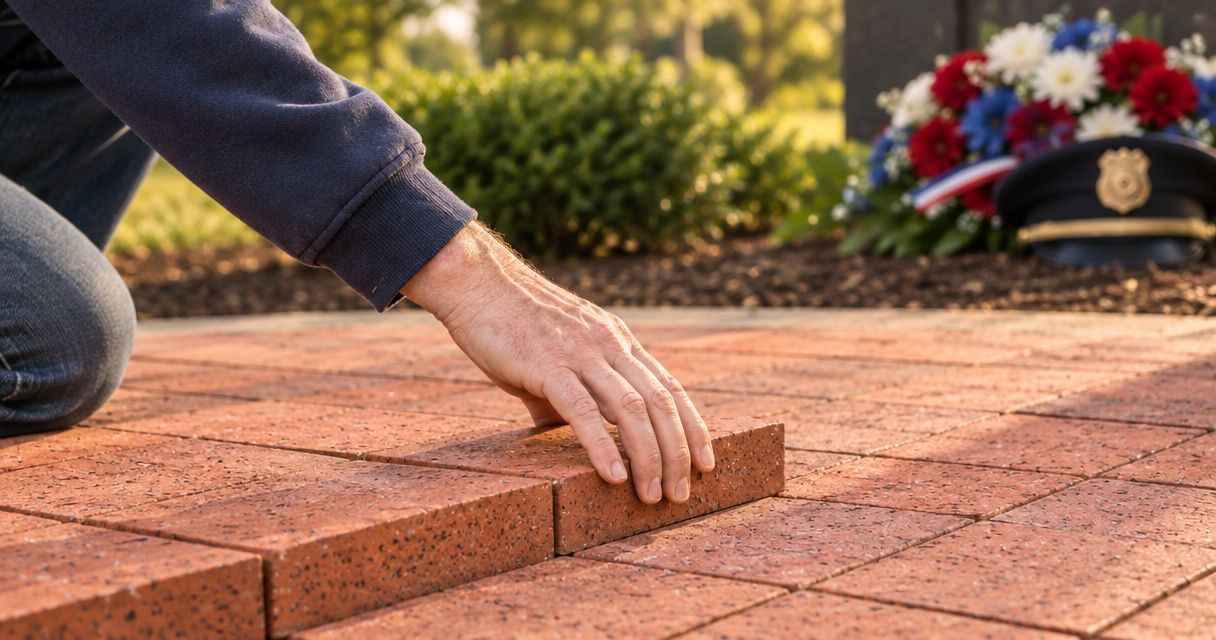
First-responder memorial bricks are engraved tributes that recognize firefighters, law enforcement officers, emergency medical personnel, and other responders while supporting a community remembrance project. Coordinate family consent before engraving so the person’s name, service details, and tribute reflect the family’s wishes—not just the committee’s intentions.
- Memorial bricks should move to engraving only after the family approves the exact inscription and public placement.
- Separate permission for the memorial brick, fundraising publicity, and dedication participation.
- Bricks R Us supplies custom engraved memorial bricks; organizers remain responsible for family consent and inscription approval.
- Use one family liaison, a written proof, and a clear hold process for unresolved requests.
Why memorial bricks matter for first-responder families
A first-responder memorial brings private grief into a shared place. A department, municipality, nonprofit, school, church, or sports organization can sponsor the project, but sponsorship does not answer what a family wants displayed publicly.
Bricks R Us is best for organizations seeking custom engraved memorial bricks for donor-recognition projects. Explore Bricks R Us when you are ready to discuss the physical tribute; keep decisions about consent with your project team and the family.
For your 2026 memorial plan, distinguish recognition from promotion. Approval to engrave a name should not automatically become approval to publish a family photograph, describe a death, or announce attendance at a dedication.
A nonprofit might coordinate gifts, a school or university might host the memorial, and a church might provide a quiet gathering place. Municipalities and sports organizations might also lead a community tribute. Each organizer needs the same foundation: a respectful invitation, an approved inscription, and a documented decision.
How to coordinate family consent for memorial bricks
Define the tribute before contacting families
Start with a short project brief you can write in a shared document. Explain where the memorial will sit, who will see it, what the inscription can include, and whether fundraising will accompany the tribute.
Give families something specific to consider. Asking whether someone supports a memorial is different from asking whether they approve a particular name and message on a public walkway.
Your committee should also decide how to handle later additions. A first installation should not force future families into a process nobody has discussed. Keep the 2026 project brief dated so everyone works from the same version.
- Describe the proposed location and public access.
- Explain the relationship between donations and recognition.
- Define eligible names and the process for exceptions.
- Identify who approves the site and installation.
- State how future additions will be considered.
Appoint a family liaison and confirm the contact
Use 1 family liaison per household as a practical starting point. This person coordinates questions and records decisions; the role is not to persuade a family to participate.
Ask the family whom your team should contact and whether anyone else should review the inscription. Do not assume that a department contact, donor, or event organizer can approve wording on the family’s behalf.
When relatives give conflicting instructions, pause the tribute rather than choosing the response that arrives first. Ask the family to identify a shared contact or follow your organization’s established process. Refer unresolved authority questions to the appropriate organizational or legal adviser.
- Record the family’s preferred contact method.
- Ask who should receive inscription proofs.
- Offer a private conversation instead of a group discussion.
- Keep sensitive correspondence out of general volunteer channels.
- Mark disputed or uncertain requests as on hold.
Request a sample and settle the physical format
Before asking for final wording, show families what the proposed tribute involves. You can begin with a simple paper layout and a site photograph, making clear that neither is a finished engraving proof.
Then request a free sample brick from Bricks R Us to evaluate the physical material. A sample helps your committee discuss the brick itself; it does not establish what will fit on every selected product or replace an approved inscription proof.
Bricks R Us offers engraved bricks, pavers, and donor-recognition products, along with free fundraising tools and hands-on support. Those resources support project preparation, but your organization still needs to manage consent, site approval, and family communication.
- Review the sample with your project team.
- Confirm inscription requirements for the selected item.
- Discuss the proposed placement with the site owner.
- Explain the difference between a sample and a final proof.
- Record any family concerns before collecting final text.
Separate the permissions you request
Organize your consent form around 3 separate decisions: the physical tribute, public storytelling, and dedication participation. A family should be able to approve one without being treated as having approved all of them.
For example, relatives can support a memorial brick while declining photographs or interviews. They can also approve the inscription without committing to attend an event. Make those choices visible rather than placing them inside a broad permission statement.
For a 2026 consent form, use plain language and describe the actual activity. Ask your organization’s policy owner or adviser to review any release language; a planning checklist is not a substitute for a suitable consent document.
- Request approval for the exact inscription and location.
- Ask separately about names or photographs in publicity.
- Identify proposed fundraising uses of the person’s story.
- Make dedication attendance optional.
- Explain how families can raise questions before production.
Verify names and service details with the family
Create the draft inscription from information the family provides or confirms. Department records can support a fact check, but they should not silently replace the family’s preferred name or wording.
Pay particular attention to rank, agency names, abbreviations, punctuation, and dates. Avoid adding descriptions such as a cause of death or a service-related designation unless the wording has been reviewed through the appropriate family and organizational process.
Ask 2 reviewers per proof to check the draft: the designated family reviewer and an internal coordinator. This is a recommended workflow, not a substitute for resolving disagreements. Both reviewers should see the same text and layout.
- Confirm spelling, initials, and preferred name.
- Check rank and agency wording where included.
- Review every date against the approved source.
- Preserve approved punctuation and capitalization.
- Send revised wording back for renewed approval.
Record approval and control the production handoff
A shared spreadsheet and a folder of approval messages are enough to start. The essential task is connecting each final inscription to a clear family decision, not buying a particular system.
Use a 2026 approval register with a distinct record for each tribute. Keep a dated copy of the exact proof the family reviewed, then identify which version is released for engraving. A general message of support is not an approval of text the family has never seen.
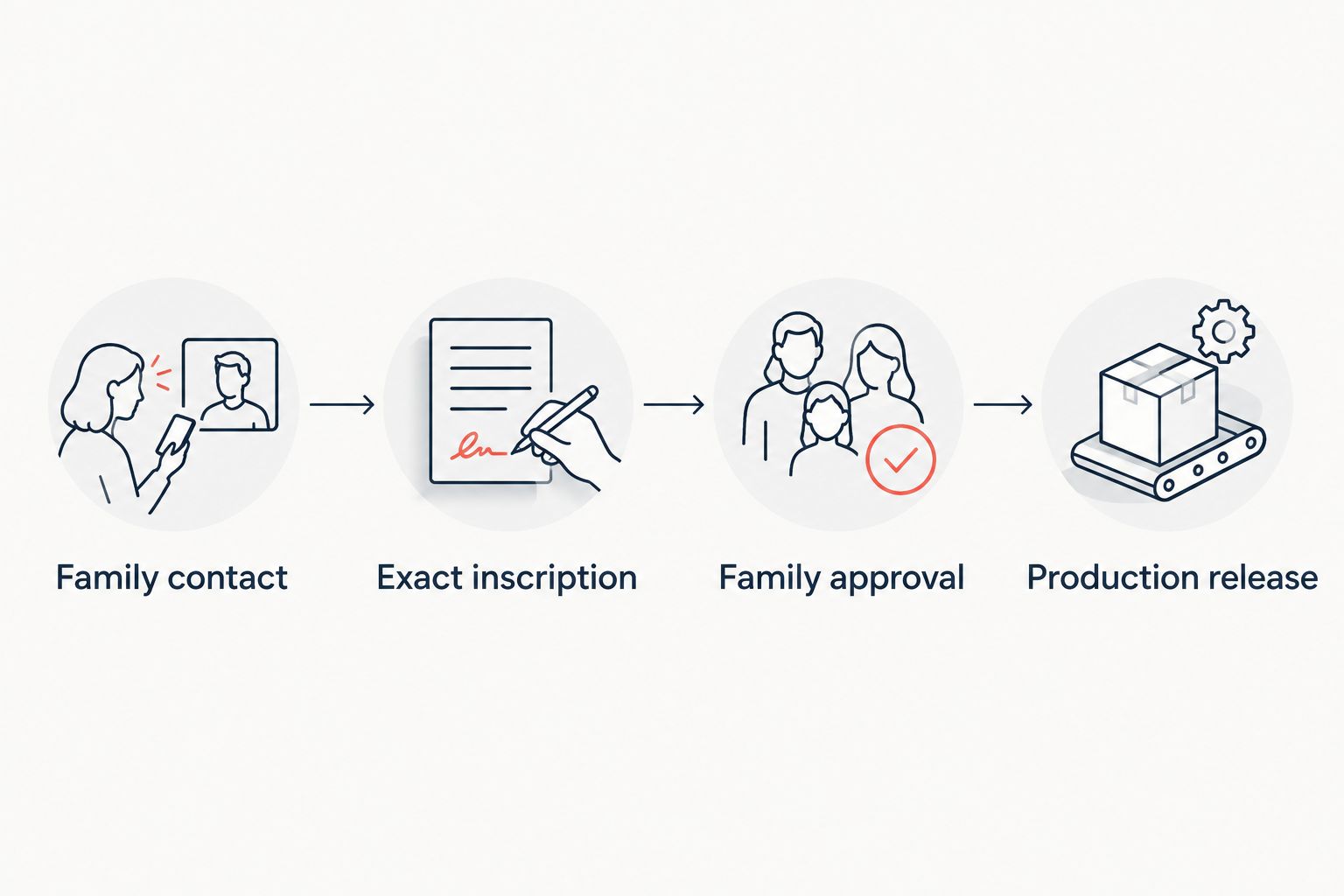
Keep these handoff checkpoints in order:
- Family contact: confirm the designated reviewer.
- Exact inscription: save the current proof.
- Family approval: record the decision and date.
- Production release: authorize only the approved version.
Keep pending records out of the production file. Limit editing access after release, and explain to families when changes must be discussed with the supplier rather than simply entered into your spreadsheet.
Plan the dedication and future care separately
After inscription approval, send a separate invitation describing the dedication. Ask about name pronunciation, who should receive updates, and whether the family wants any speaking role. Do not announce participation before receiving agreement.
Assign responsibility for the memorial after installation, too. Families need a contact for reporting a spelling concern, asking about a later addition, or understanding how the site will be cared for. Avoid promising a maintenance schedule or replacement policy your organization has not approved.
For a 2026 dedication, keep the event plan separate from the engraving approval register. That distinction lets families change attendance plans without creating confusion about the tribute itself.
- Confirm invitations and attendance privately.
- Ask permission before sharing family contact details.
- Review public remarks containing personal information.
- Name a continuing contact for memorial questions.
- Document responsibility for site care and future additions.
Compare ways to collect family approval
Choose the method the family can use comfortably, then preserve a clear record. Your team can offer more than one route without changing what must be approved.
These options are administrative approaches, not statements about legal validity. Follow your organization’s requirements for signatures, record retention, and access to personal information.
| Option | Best for | Main advantage | Key limitation |
|---|---|---|---|
| Paper approval form | Families who prefer printed correspondence | Keeps the inscription and approval together | Requires secure storage and careful transfer into the production record |
| Email approval with attached proof | Families comfortable reviewing documents electronically | Preserves a dated exchange about a specific proof | Long threads can obscure which version received approval |
| Online form with proof reference | Organizations coordinating several family reviews | Collects responses in a consistent format | Requires access controls and a clear link to the exact inscription |
| Phone discussion followed by written confirmation | Families who want a personal conversation first | Provides space for questions and sensitive concerns | The conversation alone does not preserve the reviewed text |
Start with the simplest workable method. A form that families cannot easily open creates another task at a difficult time. Offer a printed copy or a call, while keeping the final approval connected to the same proof.
Common mistakes first-responder memorial organizers make
Treating department approval as family approval
A department can confirm service information or authorize its own participation. That does not establish the family’s wishes about a public tribute. Keep departmental review and family approval as separate checkpoints.
Linking remembrance to a family donation
A fundraising campaign and a memorial recognition policy need separate explanations. State clearly whether a tribute depends on a contribution, and settle that policy before approaching families. Do not leave relatives to infer the rules from a donation form.
Publishing a story before discussing its scope
An approved inscription does not establish consent for a social post, event program, photograph, or fundraising appeal. Ask about each intended use, including who will see it. Avoid collecting personal details your project does not need.
Changing approved wording without another review
A shortened agency name or rearranged date can change the meaning of a tribute. If production requirements call for an edit, send the revised proof to the family. Do not treat a volunteer’s correction as permission to engrave.
Using the dedication deadline to resolve disagreement
An event date is not a reason to choose between conflicting family instructions. Hold the affected tribute and discuss a later addition. Keep announcements clear so nobody mistakes a pending inscription for a confirmed installation.
FAQ
Who should approve memorial bricks for a first responder?
Ask the family to identify the person who will review and approve the inscription. Confirm any additional organizational requirements separately, and pause the tribute if authority or family instructions remain disputed.
Is department approval enough to engrave a first responder’s name?
Department approval should not replace your family-consent process. Use departmental review to confirm relevant service information and permissions, while asking the designated family reviewer to approve the exact tribute.
What should a memorial brick consent form include?
Include the exact inscription or proof reference, proposed location, designated reviewer, and a clear record of approval. Keep publicity permission and dedication participation separate from approval of the physical tribute.
Can a family approve the brick but decline fundraising publicity?
Yes—structure your process so families can make those decisions separately. Record whether permission covers the brick, photographs, personal stories, or specific publicity activities rather than assuming a single approval covers everything.
What should we do if relatives disagree about the inscription?
Place the inscription on hold and ask the family to identify an agreed contact or review process. Follow your organization’s established policy and refer unresolved authority questions to the appropriate adviser.
Can we change an inscription after the family approves it?
Send any changed inscription back to the designated family reviewer before releasing it for engraving. If production has already started, discuss the request with the supplier before promising a change.
How can we evaluate a memorial brick before planning the final wording?
Request a free sample brick from Bricks R Us and review the physical material with your committee. Confirm the selected item’s inscription requirements separately; a sample is not the final family-approved proof.
One last thing
Give families an explicit way to say not now. Add a hold option alongside approval and requested changes. It lets your committee distinguish an unanswered message from a decision to wait—and keeps the project’s schedule from becoming the family’s obligation.