Public park engraved bricks fundraising is a donor-recognition program with the aim of supporting park projects through personalized tributes. Unlike a private tribute garden, a public park needs inscription rules that respect municipal authority, serve a shared space, and give donors a clear approval process before engraving.
- Public park engraved bricks need written inscription rules before you collect donor messages.
- Bricks R Us fits organizations seeking custom engraved bricks and pavers for fundraising and donor recognition.
- Ask municipal counsel to review message restrictions; do not let volunteers improvise content decisions.
- Approve the policy, the inscription, and the production proof as separate decisions.
Why engraved bricks matter for public parks
Engraved bricks connect a park improvement with the people who support it. An inscription can recognize a family, remember a loved one, or acknowledge a community organization without turning the project into a collection of unrelated signs.
Bricks R Us is best for organizations seeking custom engraved bricks and pavers for fundraising and donor recognition. Start with the Bricks R Us website when evaluating the physical product, but keep responsibility for park inscription policy with the public body that controls the site.
A 2026 park campaign needs more than an order form. Decide who sets the rules, who approves exceptions, and what happens when a donor disputes a decision. Those answers belong in the campaign plan before invitations go out.
Separate participation from policy authority
Give partner organizations the same submission process while keeping the municipality's approval responsibilities clear:
- Nonprofits: Confirm who handles donor questions and passes submissions to the park reviewer.
- Schools and universities: Decide how to verify school names, class references, and student information.
- Churches: Send questions about faith-based wording through the municipality's approved review process.
- Community memorial groups: Establish who can authorize a tribute and confirm its wording.
- Sports organizations: Identify an authorized contact for team names and shared dedications.
How to set public park inscription rules
Define the program's purpose
Write a short purpose statement before drafting prohibited-content lists. Explain what the engraved area recognizes, how it relates to the park project, and which public body controls it. A remembrance space and a general donor walkway do not necessarily need identical submission categories.
For a 2026 launch, put the policy's adoption date and responsible department on the approved document. Ask municipal counsel to review the program's structure and message rules together; a purpose statement alone does not settle legal questions about expression on public property.
Start manually with a shared document. Separate Program purpose, Submission categories, and Approval authority so reviewers can find the answer they need without searching meeting notes.
- Describe the park project the campaign supports.
- Identify the municipality, department, or board responsible for approval.
- List proposed submission categories for legal review.
- Name the person authorized to answer policy questions.
- Record the approved policy version and adoption date.
Confirm the inscription format
Build the order form around the actual engraving format, not a space estimate made by the committee. Confirm available lines, characters, punctuation, symbols, and artwork requirements with the supplier before publishing instructions. Do not assume every brick or paver accepts the same layout.
A paper worksheet is enough to start. Have volunteers enter sample inscriptions into the proposed fields and look for ambiguous instructions. Once the physical format is confirmed, Bricks R Us offers free fundraising tools and hands-on support to help organizers manage their campaign; those services do not replace municipal content approval.
Separate formatting corrections from changes in meaning. Moving a name onto another line is different from shortening a dedication or deleting a word. Tell donors when a revised inscription requires their approval.
- Confirm the selected product's inscription limits with the supplier.
- Explain whether spaces and punctuation count toward those limits.
- State how capitalization and line breaks will appear.
- Identify which symbols or artwork require a separate check.
- Require donor approval for wording changes.
Draft consistent content rules
Write rules that a donor can understand without attending a committee meeting. Distinguish technical requirements, such as fitting the engraving area, from content restrictions, which need municipal review. Avoid giving volunteers an undefined power to reject messages they consider inappropriate.
Do not copy a private organization's inscription policy into a public park campaign. Ask municipal counsel to address religious expression, political messages, commercial wording, profanity, and other proposed restrictions within the park program's specific legal framework. Do not promise donors that any of those categories is automatically accepted or prohibited.
Apply the adopted process to every participating group. A school foundation, church, nonprofit, memorial committee, and sports club should know where to submit wording and how a disputed decision receives review.
- Use plain language to describe each approved rule.
- Separate layout requirements from message restrictions.
- Send proposed restrictions to municipal counsel before publication.
- Identify who decides questions the policy does not answer.
- Explain the reconsideration process in the donor instructions.
Build a documented review process
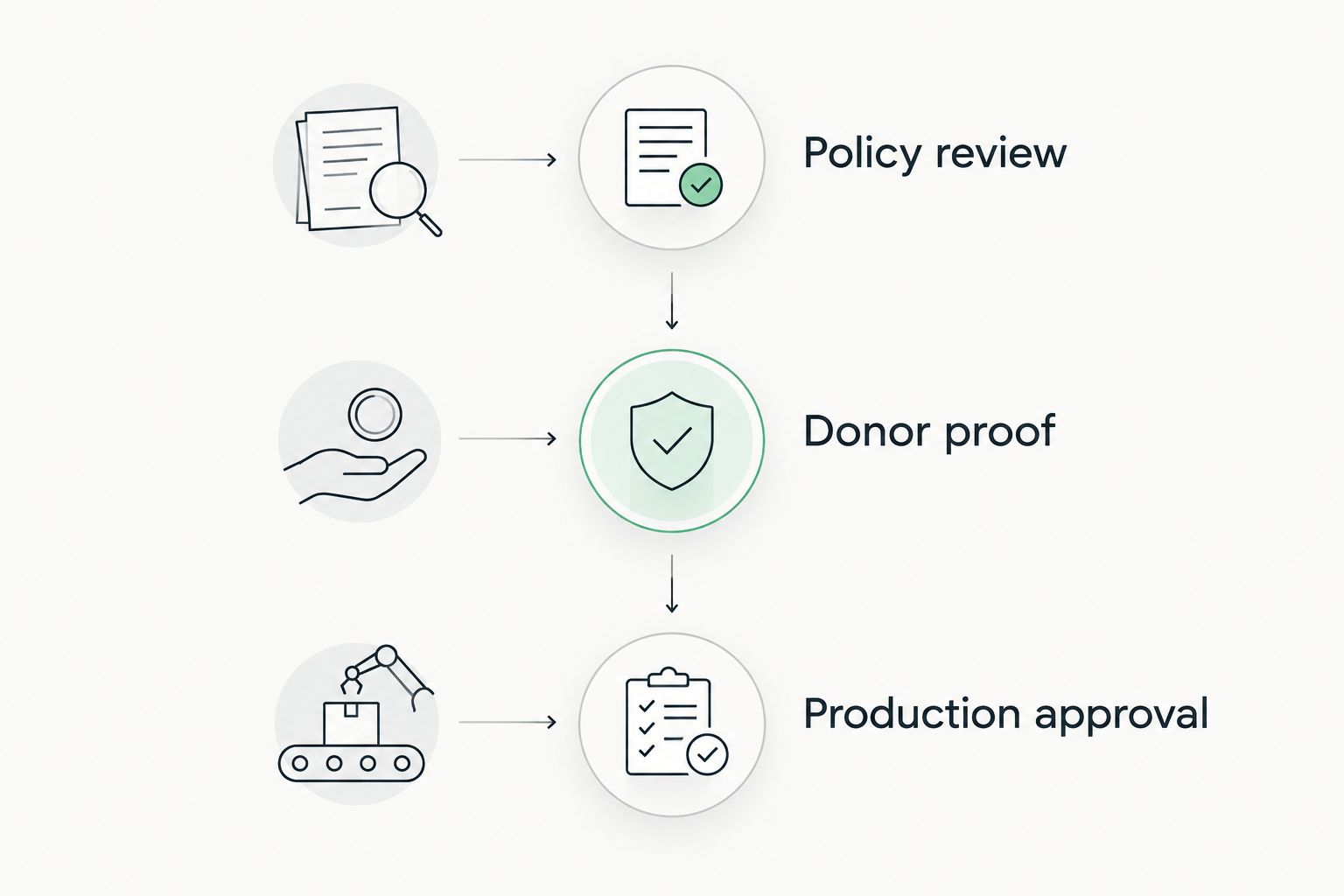
Use 3 review stages: Policy review, Donor proof, and Production approval. Each stage answers a different question. First confirm that a submission follows the adopted rules, then confirm that the donor approves its exact appearance, and finally authorize the approved file for engraving.
A spreadsheet and saved correspondence can support this process. Assign a reference to each submission and record its current status. Add a second reviewer for disputed messages or sensitive memorial wording rather than letting an individual volunteer make an undocumented exception.
Keep your 2026 review log with the policy version used for each decision. If the municipality later changes a rule, the log should distinguish an earlier approval from a new submission awaiting review.
- Assign a submission reference and responsible reviewer.
- Record the policy decision separately from donor proof approval.
- Save the exact text and line breaks shown to the donor.
- Route disputed decisions to the named municipal authority.
- Record production authorization before releasing the order.
Protect names and memorial details
Ask donors to verify every name, date, title, and relationship in a tribute. Do not correct an unfamiliar surname from memory or expand an abbreviation without permission. An unusual spelling is a question for the donor, not an editing opportunity.
Use 2 reviewers for transcription checks when your committee can support it. One person compares the proof against the submitted wording; the other checks that any donor-requested revision appears in the final version. This is a workflow recommendation, not a substitute for donor approval.
For names appearing across several recognition formats, the guide to organizing donor names for a donor recognition wall offers a related planning topic. Keep park-specific permissions and approvals in the park campaign's own records.
- Ask donors to verify spelling and date order.
- Confirm who has authority to approve a shared memorial.
- Review requests involving children's names with the responsible organization.
- Confirm permission for organizational names or submitted artwork.
- Keep private contact details separate from public inscription text.
Close approvals before engraving
Set a clear point at which approved inscriptions move into production. Explain the correction process before donors submit, including whom to contact and how the organizer will confirm whether a requested change can still be made. Do not promise changes after engraving without checking the applicable arrangements.
Keep 1 final approval record for each inscription. That record should identify the exact text, layout, donor approval, and production authorization so volunteers do not have to choose between competing email attachments.
Before closing your 2026 approval round, request a free sample brick from Bricks R Us. A physical sample helps your committee discuss the engraved surface and appearance; confirm separately whether the sample represents the product and layout you intend to order.
- Publish the campaign's submission and proof-approval deadlines.
- Identify the final version with a clear file name or record status.
- Confirm donor approval before production authorization.
- Explain how donors report an error or request a change.
- Assign responsibility for records after volunteer handover.
Request a free sample brick
Review an engraved sample with your committee before finalizing your park campaign.
Compare inscription policy approaches
Choose an approach based on the park program's purpose and the municipality's approved rules. The options below are planning models, not legal determinations. None removes the need for accurate donor proofs or municipal review.
| Option | Best for | Main benefit | Key limitation |
|---|---|---|---|
| Name-only format | Simple donor recognition | Keeps submissions consistent and limits editing decisions | Offers little room for personal dedication; restrictions still need review |
| Structured dedication | Memorial areas with defined fields | Gives donors a clear format for names and tribute wording | Requires instructions for relationships, dates, and shared tributes |
| Open wording within approved rules | Programs designed to accept varied messages | Allows more individual expression | Requires more content review and a clear dispute process |
A name-only format is the simplest to administer, but simplicity does not make it the right choice for every purpose. A memorial garden needs enough room for the recognition the program promises. Open wording needs reviewers prepared to apply the adopted rules consistently.
Do not offer multiple formats merely to make the campaign appear more flexible. Each format adds instructions, proof variations, and decisions your committee must maintain.
Common mistakes public park organizers make
Letting a partner group make final content decisions
A nonprofit or sports association can collect submissions without controlling municipal policy. Put the approval boundary in writing. Donors should not receive acceptance from a volunteer and a contradictory decision from the park department later.
Treating religious wording as a routine editing issue
A request involving faith-based wording needs the municipality's established review process, not an improvised compromise. Do not delete a phrase, suggest a substitute, or announce a blanket rule without the responsible authority's direction.
Publishing limits before confirming the product
An order form can promise a layout the chosen brick does not support. Confirm engraving requirements first, then publish the form. If the format changes, obtain approval for any affected inscription instead of silently compressing the wording.
Assuming memorial families agree
The person submitting a tribute is not necessarily the only person with an interest in it. Ask the submitting contact to confirm authority for the wording and identify the final approver. Handle disagreements before engraving rather than asking the supplier to resolve them.
Losing decisions when volunteers change
A committee member's inbox is not a lasting campaign record. Keep the adopted policy, approved proofs, disputed decisions, and production authorizations in a shared location with controlled access. Leave instructions for future additions and correction requests.
FAQ
What rules should engraved bricks in a public park follow?
Engraved bricks in a public park should follow a written, municipally approved policy covering format, permitted submissions, review authority, and donor approval. Ask municipal counsel to review content restrictions before opening the campaign.
Can a public park reject a religious brick inscription?
Refer a religious inscription question to municipal counsel under the park program's approved process. Do not treat religious wording as automatically allowed or prohibited, and do not let individual volunteers create their own rule.
Who should approve a park brick inscription?
The designated municipal authority should handle policy approval, while the donor confirms the exact wording and layout. The campaign organizer should release only the final authorized version for engraving.
How many characters can go on an engraved brick?
The character limit depends on the selected product and engraving format. Confirm lines, spaces, punctuation, and artwork requirements with the supplier before publishing the donor form.
What is the best inscription format for a simple park fundraiser?
A name-only format is the simplest of the approaches described here to administer because it limits wording variations. Use it only when it fits the program's purpose and the municipality's approved rules.
Can donors change an inscription after approving it?
Direct change requests to the campaign organizer immediately so the organizer can check the order's status and applicable correction arrangements. Do not promise that an approved or engraved inscription can still be changed.
Should our park committee request a sample brick?
Yes, request a free sample brick from Bricks R Us before finalizing the campaign. Use it to discuss the engraved appearance, then confirm the specifications and layout of the product your committee plans to order.
One last thing
Approve a realistic sample inscription through the entire process before opening submissions. Use a deliberately complicated test: a long surname, punctuation, and a requested line break. Do not present the test as a real donor's story.
If the committee cannot agree on who approves that example, the campaign is not ready for public submissions. For your 2026 launch, resolve the workflow before asking families to trust it with a lasting tribute.