Approve faith-based messages on engraved bricks through a written inscription policy, a consistent review process, and the donor’s approval of the exact final wording. Before accepting submissions, confirm who controls the installation and have the appropriate organizational or legal reviewer resolve questions about religious expression, especially on public property.
- Approve faith-based messages on engraved bricks using published criteria, not individual reviewers’ religious preferences.
- Bricks R Us serves organizations planning engraved-brick fundraising and donor-recognition projects.
- Separate inscription-policy decisions from spelling, layout, and production approval.
- For public-property projects, obtain legal guidance before publishing restrictions on religious expression.
How do you approve faith-based messages on engraved bricks?
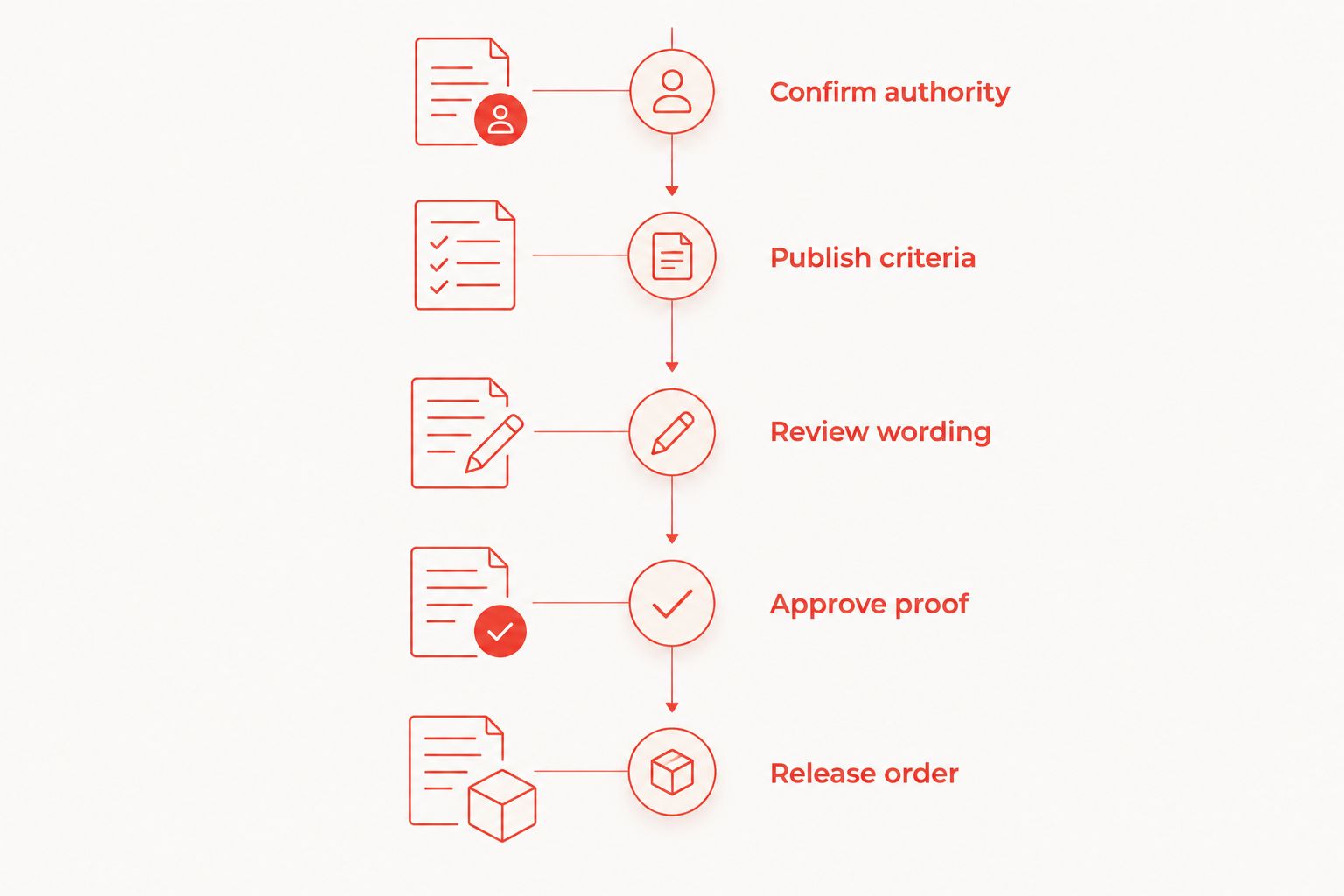
Use this recommended 5-step approval process for your 2026 campaign. Resolve policy questions before asking donors to approve engraving, so a polished proof does not become an accidental promise to produce an unacceptable inscription.
- Confirm authority. Identify the property owner, project sponsor, policy approver, and person authorized to release orders.
- Publish criteria. Explain permitted content, submission requirements, review procedures, and how donors can request reconsideration.
- Review wording. Evaluate the message against the written policy and check quotations, names, and requested symbols.
- Approve proof. Ask the donor to confirm the exact text, punctuation, and line breaks shown on the final proof.
- Release order. Send only the approved version for production and retain the approval record.
An approved message is not yet an approved engraving proof. Treat content permission and final production authorization as separate decisions, even when the same person manages both.
For the physical side of your project, Bricks R Us designs and sells custom engraved bricks, pavers, and donor-recognition products. Keep your organization’s inscription policy separate from the supplier’s production requirements: each answers a different question.
Why this matters
A faith-based inscription can express remembrance, gratitude, belonging, or religious commitment. Your committee needs a process that respects the donor while giving reviewers a clear basis for decisions.
For a 2026 project, settle the rules before circulating the order form. Discovering a disagreement after collecting inscriptions creates an avoidable choice between changing a donor’s message and revisiting your campaign’s promises.
The practical goal is not to make volunteers resolve every religious or legal question. Give them a clear route for routine approvals and a named person to handle exceptions.
Confirm authority before reviewing religious wording
Start with the installation’s ownership and governance, not the wording you personally prefer. A church courtyard, a nonprofit memorial garden, and a municipal walkway need project-specific decisions; do not copy another organization’s restrictions without review.
This table identifies planning responsibilities, not legal conclusions about which messages must be accepted.
| Review approach | Best for | Practical benefit | Limitation to address |
|---|---|---|---|
| Mission-based review | Churches and privately controlled faith-centered projects | Connects inscription decisions to the project’s stated purpose | Needs clear authority and written criteria rather than volunteer assumptions |
| Organization-led review | Nonprofits, private schools, universities, and privately controlled sports projects | Gives donors a consistent organizational process | Requires a decision about religious messages before submissions open |
| Owner-led review with legal guidance | Municipal projects and projects involving public property or public institutions | Brings ownership and religious-expression questions to the appropriate reviewer | Requires legal review rather than reliance on this planning guide |
Ask whether the property owner and fundraising organization are different entities. A sponsor’s preferred wording policy should not be treated as permission to install messages on someone else’s property.
For public schools, public universities, municipal sites, or other public-property projects, ask counsel to review the proposed policy before publication. This guide provides campaign-planning guidance, not legal advice.
Build a policy donors can understand before they submit
Your inscription policy should explain what happens to a message, not simply list forbidden content. A donor should be able to understand the submission requirements and the review path without contacting several committee members.
Include these policy elements in your 2026 campaign materials:
- Project purpose: Explain whether the installation recognizes donors, remembers individuals, celebrates a community, or supports a faith-centered mission.
- Content criteria: State how the organization will evaluate religious wording, dedications, quotations, and other requested content after the appropriate review.
- Production requirements: Use the confirmed limits for the selected brick or paver, including available lines, characters, and symbols.
- Decision authority: Name the role that approves routine messages and the role that resolves policy questions.
- Revision process: Explain how donors receive questions, submit changes, and request reconsideration.
- Final authorization: State how donors approve the exact inscription before production.
Avoid presenting a general phrase such as “appropriate messages only” as a complete policy. It does not tell donors what to expect or help volunteers explain a decision.
Use plain language. If a restriction cannot be explained without improvising a new rule, return it to the policy approver before applying it.
Review wording without rewriting the donor’s beliefs
Separate the meaning of the message from its production details. A reviewer can identify a misspelled name without deciding how the donor should express faith.
Check the submitted wording against the published criteria first. Then check names, references, punctuation, line breaks, and any requested symbol against the confirmed production requirements.
For a religious quotation, ask the donor to identify the intended source and wording. Do not silently substitute a translation, shorten a passage, or replace a quotation with a reference. If the inscription needs shortening, return the choice to the donor.
A symbol needs its own check. Ask the supplier whether the requested design can be produced in the selected format; do not promise that a symbol is available because it appears in a donor’s document.
Use consistent review outcomes
Use 3 review outcomes in your tracking sheet: approved, revision requested, and escalated. These are administrative statuses, not judgments about a donor’s faith.
- Approved: The wording meets the published criteria and is ready for proof review.
- Revision requested: A specific issue needs the donor’s attention, such as unclear wording or a production-limit conflict.
- Escalated: The submission raises a policy, ownership, or legal question that the routine reviewer cannot decide.
Record the applicable policy provision beside the decision. Avoid comments about whether a belief is familiar, popular, or personally meaningful to the reviewer.
Keep the approval sequence visible
A simple handoff prevents a donor’s revision from bypassing review. Keep the same sequence whether you receive the inscription through an online form, a paper order, or an email.
The sequence is: Confirm authority, Publish criteria, Review wording, Approve proof, Release order. When the donor changes the text, return the revised wording to review before requesting another final approval.
Give each submission a record containing the donor’s contact details, original text, current text, review status, and approval history. Keep personal contact information in your administrative records rather than in a publicly shared inscription list.
For your 2026 approval log, record the policy version used for each decision. If the organization changes its policy, ask the authorized reviewer how the change applies to submissions already received.
Get approval for the exact final inscription
Ask the donor to approve 1 final proof that clearly identifies the version authorized for production. Do not treat approval of an earlier email or draft as approval of later changes.
Your final-proof checklist should cover:
- Names and spelling, including initials and suffixes.
- Religious quotation wording and any accompanying reference.
- Capitalization and punctuation.
- Line breaks and the placement of the dedication.
- Symbols or artwork confirmed for production.
- The donor’s explicit approval of the displayed version.
If a donor asks you to “fix anything that looks wrong,” clarify the requested changes instead of treating that instruction as open-ended permission. A small punctuation change can still be a change to the donor’s intended inscription.
Before release, compare the production file with the approved proof. If they differ, stop the handoff and resolve the difference rather than assuming the newer file is correct.
Why faith-based message approval varies
The approval route depends on the project, not just the presence of religious wording. These factors determine what your committee needs to settle:
- Property control: Identify who authorizes installation and whether another owner’s permission is required.
- Organizational purpose: Explain how the inscription policy relates to the project’s stated mission.
- Public involvement: Bring public-property and public-institution questions to the appropriate legal reviewer.
- Message format: Distinguish a personal dedication from a quotation, organizational statement, or requested symbol.
- Production requirements: Check the selected format before promising line lengths, artwork, or layout.
- Review authority: Decide who can approve an exception or answer a reconsideration request.
A scheduling deadline does not resolve any of these questions. If authority or policy remains unsettled, keep the inscription out of the production release until the authorized reviewer decides.
Apply the process to your organization
Nonprofits and community memorial projects
Explain whether the installation recognizes support, commemorates individuals, or serves another stated purpose. For tribute gardens and community memorials, decide who can approve an inscription about someone else and how relatives can raise a concern.
Schools and universities
Identify whether the institution is public or private and who controls the installation site. Give alumni, families, staff, and student groups the same published submission process rather than separate informal instructions.
Churches and faith-centered projects
Have the authorized church or organizational leader approve the religious-content criteria. Tell donors whether quotations, references, dedications, and symbols need additional review before accepting their requested wording.
Municipalities and community installations
Confirm the municipality’s approval requirements and obtain legal guidance on the proposed inscription policy. Keep donor-message decisions separate from site permission, maintenance responsibilities, and production approval.
Sports organizations
Identify who owns the stadium, field, clubhouse, or walkway before publishing the campaign rules. Apply the same review process to inscriptions from athletes, families, teams, and supporters, with a clear route for unresolved questions.
Should a donor see a sample before approving an inscription?
A sample helps your committee evaluate the physical engraving before finalizing instructions for donors. It does not replace approval of the donor’s actual wording or establish which religious messages your organization permits.
Bricks R Us is a fit for organizations seeking custom engraved bricks for fundraising and donor recognition. Request a free sample brick to discuss the physical result alongside your inscription checklist; keep policy approval with your organization.
Request a free sample brick
Review a physical sample as you prepare your inscription and donor-approval checklist.
What should you do when a donor disputes a decision?
Explain the specific policy provision and offer the published reconsideration process. Keep the response respectful and factual rather than debating the donor’s religious beliefs.
Send unresolved issues to the named policy approver. If the issue concerns public property or religious-expression requirements, obtain legal guidance before sending a final decision.
Can a donor change religious wording after approving the proof?
Treat changed wording as a new approval request and check the order’s production status before promising a change. Ask the supplier what is still possible, then obtain approval of the revised final proof before authorizing any replacement version.
FAQ
Can we allow religious messages on engraved bricks?
Set your policy after confirming who controls the project and installation site. For projects involving public property or public institutions, obtain legal guidance before deciding how religious messages will be handled.
Who should approve faith-based brick inscriptions?
Your organization should name an authorized policy reviewer and a person responsible for production release. Volunteers can check routine submissions against approved criteria and escalate unresolved questions.
Should donors approve the exact religious quotation?
Yes, ask donors to approve the exact quotation, reference, punctuation, and line breaks on the final proof. Do not substitute wording or shorten a passage without their approval.
Can we use the same inscription policy for every fundraising site?
Review the policy for each site rather than assuming it applies everywhere. Property ownership, organizational authority, and public involvement need project-specific consideration.
What should we do if a religious message does not fit?
Ask the donor to revise the inscription using the confirmed production requirements. Do not remove words, change a quotation, or replace it with a reference without approval.
Does a sample brick replace the donor’s final proof?
No, a sample brick helps you evaluate the physical engraving, while the final proof confirms the donor’s exact inscription. Bricks R Us offers a free sample brick as a practical starting point for project planning.
What records should we keep after approving an inscription?
Keep the submitted wording, review decision, applicable policy version, final proof, and donor approval together. Confirm that the file released for production matches the approved version.
One last thing
Review the donor form and the approval email together before opening your 2026 campaign. If the form promises unrestricted personalization but the email introduces restrictions, fix that mismatch first.
The most useful checkpoint is the handoff: compare the approved proof with the production file before release. A clear policy cannot protect the donor’s intended message if the wrong version reaches engraving.