Organize a school brick fundraiser volunteer team by assigning clear owners for campaign decisions, donor communication, inscription records, financial reconciliation, and site coordination. Give every task a backup, keep one approved order record, and require donor approval before submitting engraving details. Start with school permission and a written handoff process so volunteers know who can approve changes.
- A school brick fundraiser needs named task owners, donor-approved inscriptions, and a clear submission handoff.
- Bricks R Us is a fit for organizations seeking custom engraved bricks for fundraising and donor recognition.
- Keep school approvals, financial records, and inscription checks separate, even when volunteers share responsibilities.
- Request a free sample brick before your committee finalizes donor-facing descriptions.
How do you organize a school brick fundraiser volunteer team?
Build the team around responsibilities, not committee titles. A chairperson cannot keep a campaign moving if everyone assumes someone else is checking donor names or confirming permission to use the proposed site.
Use this sequence to prepare your team. The guide to preparing your brick fundraiser committee provides a related starting point for organizing committee discussions.
- Confirm the school's approval process and project purpose.
- Assign an owner and backup for each responsibility.
- Agree on a shared order record and donor approval process.
- Review a sample before publishing campaign materials.
- Establish the handoff from approved orders to site coordination.
Assign responsibility before asking volunteers to promote the fundraiser. Promotion creates questions and orders; your team needs a dependable way to handle both.
Why this matters
A brick fundraiser connects a fundraising goal with permanent donor recognition. Unlike a temporary event sign, an engraved name becomes part of a physical installation, so spelling, placement, and approval deserve deliberate attention.
For a 2026 school campaign, write down which decisions belong to volunteers and which require school authorization. Volunteers can organize records and communication, while school representatives confirm the applicable rules for facilities, finances, privacy, and public messaging.
This approach also supports continuity. A parent volunteer can step away without taking the campaign's only copy of donor approvals, unresolved questions, or installation correspondence with them.
Assign the volunteer responsibilities
Campaign coordination
Choose a campaign coordinator who keeps decisions moving and makes unresolved questions visible. This person maintains the task list, schedules discussions when a decision is needed, and confirms that every responsibility has an owner.
The coordinator should not automatically become the engraving approver, financial reviewer, and facilities contact. Combining every decision under one volunteer creates a single point of failure.
Give the coordinator a clear brief: explain the project's purpose, record decisions, and escalate issues to the appropriate school representative. Name a backup who can access the current records without relying on a private inbox.
Donor communication
Assign a communication owner to prepare campaign announcements, respond to common questions, and send reminders. Use school-approved channels rather than assuming volunteers can contact families through any available list.
Prepare a consistent explanation of what supporters are contributing toward, how inscriptions are submitted, and how approvals work. Avoid promising an installation date until the relevant parties have confirmed it.
The communication owner should maintain a short list of approved answers. Questions about engraving requirements, site access, or financial procedures belong with the appropriate decision-maker rather than receiving an improvised answer.
Inscription records
Assign a records owner to maintain donor details, requested wording, corrections, and approval status. Preserve the donor's submitted text and the final approved version so reviewers can distinguish a request from a confirmed inscription.
Use explicit statuses such as awaiting review, correction requested, donor approved, and submitted. These labels describe different stages; a paid contribution does not establish that its inscription is ready for engraving.
Protect the information volunteers handle. Keep donor contact information separate from public recognition lists, and give volunteers access only to the records their work requires.
Financial reconciliation
Ask the school or authorized fundraising organization to identify who handles contributions and reconciles financial records. Volunteers should follow that organization's procedures rather than create a parallel collection process.
Match each order record with its financial status through an internal reference. Do not use a donor's payment details as the shared committee reference.
Financial confirmation and inscription approval are separate checks. A campaign needs both, but neither replaces the other. Record who resolves discrepancies and who confirms that an order can move forward.
Site coordination
Name a facilities liaison who communicates with the school representative responsible for the proposed location. This volunteer gathers questions and records answers; the role does not replace qualified installation advice or school authorization.
Confirm who approves the location, who coordinates installation, and who maintains the finished area. Ask how future additions would be handled before presenting the installation as an ongoing recognition opportunity.
For a 2026 project, keep site decisions alongside campaign decisions. A volunteer recruiting donors should be able to find the approved description without guessing what the facilities discussion settled.
Choose a staffing model your volunteers can sustain
A small committee can combine responsibilities, while a larger committee can distribute them. The right arrangement is the one that preserves clear ownership and independent checks without creating unnecessary meetings.
| Staffing model | Best for | Advantage | Trade-off | Safeguard |
|---|---|---|---|---|
| Combined responsibilities | Schools with a small volunteer pool | Fewer handoffs between volunteers | Absences can interrupt several tasks | Assign a backup and retain a separate final reviewer |
| Separate task owners | Schools with enough volunteers for specialized roles | Makes responsibilities easier to identify | Requires more coordination between owners | Use one shared status record and a documented handoff |
Do not recruit people into vague positions such as general helper when you already know the work. Offer a defined task: checking approved wording, drafting an announcement, reconciling records, or gathering site questions.
Tell prospective volunteers what authority accompanies the task. Someone checking spelling should know whether they can contact donors directly or must send questions through the communication owner.
Build an order process volunteers can follow
Use a shared record that separates intake, review, approval, and submission. A spreadsheet or an organization-approved system can work; the essential requirement is that volunteers know which record is authoritative.
Collect the request
Record the donor's contact information, requested inscription, and any information your organization requires to reconcile the contribution. Collect only what the campaign needs, following the school's privacy procedures.
Explain the approval process when the donor submits a request. Do not leave supporters to discover later that additional confirmation is needed before their wording can be submitted.
Review the wording
Check the requested inscription against the confirmed engraving requirements. Verify names, punctuation, capitalization, and any school rules governing recognition text.
Do not silently rewrite a tribute to make it fit. Return the proposed wording to the donor and explain what needs clarification or adjustment.
Obtain donor approval
Send the exact proposed inscription for approval through the school's approved communication process. Keep the response with the corresponding order record so another volunteer can verify it.
A conversation remembered by one committee member is not a dependable handoff. Record the approved wording and its approval status in the shared system.
Authorize submission
Have the designated reviewer confirm inscription approval, financial status, and any required school authorization before releasing the order. Record what was submitted, not just what the committee intended to submit.
Keep later changes separate from the submitted version. Ask about the applicable correction process before promising that an alteration can still be made.
Why volunteer workloads vary
The work depends on the campaign's decisions and the number of unresolved questions, not simply the number of committee members. Discuss these factors before assigning tasks:
- Approval requirements: School leadership, fundraising representatives, and facilities staff can have different decisions to make.
- Inscription complexity: Names, memorial wording, and organizational recognition require careful review rather than assumptions.
- Communication channels: Family announcements, alumni outreach, congregation notices, and team communications need appropriate permission and ownership.
- Site decisions: An approved location gives volunteers a clearer description to share than a proposed location still under review.
- Volunteer continuity: Holidays, graduation, staff changes, and committee turnover make accessible records and backups essential.
- Future additions: An ongoing recognition project needs a documented process for later requests and site coordination.
Use these factors to adjust responsibilities, not to pressure volunteers into taking on undefined work. When a task expands, clarify its boundaries and arrange help.
Review a sample before volunteers describe the project
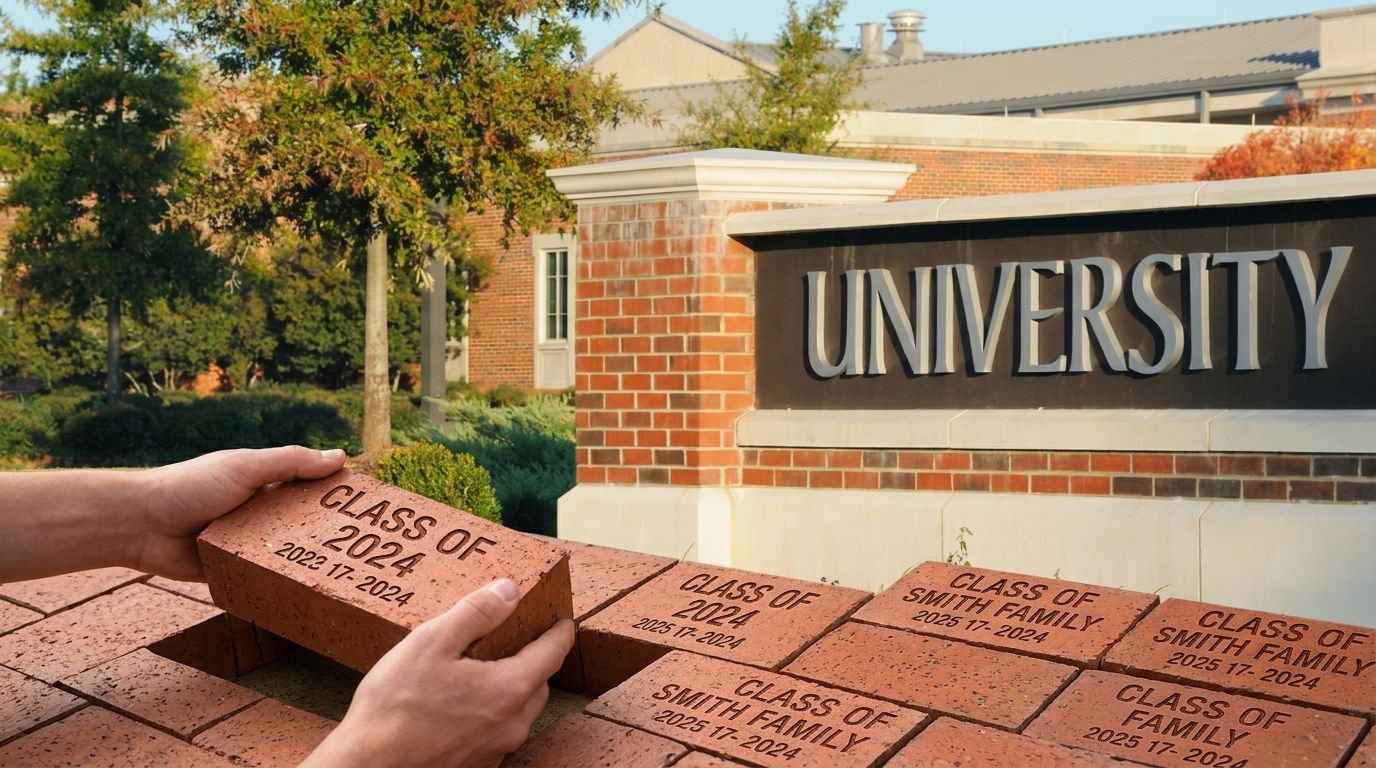
Bricks R Us is a fit for organizations seeking custom engraved bricks for fundraising and donor recognition. Request a free sample brick so your committee can examine a physical example before finalizing donor-facing descriptions.
A sample gives volunteers something concrete to discuss, but it does not replace confirmation of your project's engraving requirements, installation plan, or school approvals. Treat product review and project authorization as separate decisions.
Bricks R Us offers custom engraved bricks, pavers, and donor-recognition products, along with free fundraising tools and hands-on support. Its over 35 years of experience gives your committee a relevant source for product and ordering questions; your school remains responsible for its own permissions and procedures.
Request a free sample brick
Review a physical sample with your committee before finalizing donor-facing descriptions.
Keep the work manageable across school communities
For a 2026 campaign, recruit volunteers around the community the project serves rather than relying only on the current parent committee. Match outreach to the organization's approved channels and keep the same inscription safeguards across groups.
- Schools and universities: Coordinate family, student, staff, and alumni communication without assuming access to every contact list.
- Nonprofits: Connect recognition wording to the approved campaign purpose and distinguish donor requests from public acknowledgments.
- Churches: Confirm who approves congregation communication and memorial wording before volunteers publish invitations.
- Municipalities and community memorial projects: Identify the public-space decision-maker and the process for reviewing tribute text.
- Sports organizations: Clarify whether recognition represents individual supporters, teams, or an organization before collecting inscriptions.
These settings share a practical need: a volunteer must know where to send a question and who can authorize the answer. Keep the process consistent even when the outreach audience changes.
What should you cover at the first volunteer meeting?
Leave the first meeting with an agreed purpose, assigned responsibilities, and a list of decisions awaiting authorization. Review a sample inscription request together so volunteers can see how intake becomes an approved order.
Use the meeting to settle working practices rather than draft every announcement. Confirm where records live, how changes are documented, and who communicates with the school.
How do you keep the fundraiser running when volunteers leave?
Give every responsibility a backup and keep campaign records in an organization-controlled location. A replacement volunteer should be able to identify approved orders, unresolved questions, and the next required action without reconstructing private conversations.
Before your 2026 committee changes hands, review access permissions and transfer responsibility explicitly. Remove access that is no longer needed while preserving the organization's records.
FAQ
How many volunteers do we need for a school brick fundraiser?
Choose volunteers to cover campaign coordination, donor communication, inscription records, financial reconciliation, and site coordination. People can share responsibilities, but each task needs a named owner, a backup, and an appropriate review process.
Can our parent organization run the brick fundraiser?
Your parent organization should confirm the school's authorization and applicable fundraising procedures before launching. Establish who handles contributions, approves public messages, and authorizes use of the proposed site.
Who should check donor names before engraving?
A designated records owner should check donor names, and the donor should approve the exact proposed inscription before submission. Keep that approval with the corresponding order record.
What should volunteers do when a donor changes an inscription?
Volunteers should record the requested change and check whether the order has already been submitted. Obtain approval for revised wording and confirm the correction process before promising a change.
Should we choose the installation site before promoting the fundraiser?
Confirm site authorization before presenting a location as settled. Your facilities liaison should also clarify installation responsibility, maintenance, and how future additions would be handled.
Where can our committee get a sample engraved brick?
Request a free sample brick from Bricks R Us so your committee can review a physical example. Confirm the requirements for your own project separately rather than treating the sample as approval of every inscription or installation detail.
One last thing
Keep a short decision log, not just meeting minutes. Record each settled question, the person who authorized it, and any follow-up needed; this helps volunteers distinguish a proposal from an approved instruction.
Before closing your 2026 campaign, transfer that log with the final order record and site correspondence. The lasting recognition deserves a record that lasts beyond the original committee.